Smart Textiles Design Lab Blog at The Swedish School of Textiles
Publications
Radiant Textiles: A framework for designing with electromagnetic phenomena
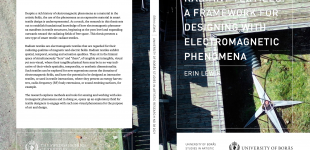
Erin Lewis Licentiate Thesis: http://hb.diva-portal.org/smash/get/diva2:1586359/FULLTEXT01.pdf Abstract [en] The design of smart, interactive, computational, and electronic textiles involves working with unknown variables that expand the tangible dimensions of textiles. Non-visual concepts such as electromagnetic fields, electrical current, computational code, and the temporal attributes of materials that exhibit dynamic qualities require that textile designers be able to […]
The Silent Context – Detachment as Leitwort for Artistic Development
Paper by Lars Hallnäs, The Swedish School of Textiles, University of Borås, available at Reserach Outlet. Abstract Post modernism as a philosophical, ideological foundation of artistic practice lives by contextualizing, relativizing; the ubiquitous context, the wandering eye, this is what it is, but on the other hand also that… What is the context? We must be […]
Around Over Between Up…: Spatial properties as variables in textile design_PhD thesis

Tonje Kristensen Johnstone, The Swedish School of Textiles Abstract With a starting point in defining space through materials, colours, planes, and surfaces, the aim of the work presented in this thesis was to explore and introduce spatial concepts as design variables in textile design. Another aim was to explore surface patterns in terms of their […]
Wearing Sound : The Foundations of Sonic Design_PhD thesis
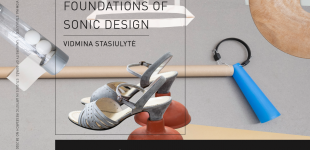
Vidmina Stasiulyte, phd student ArcintexETN(www.arcintexetn.eu) and The Swedish School of Textiles University of Borås Abstract Fashion is primarily a visual ontology consisting of definitions, theory and methods that are based on visual language. This research revises fashion by approaching it from a different—sonic—perspective wherein sound is considered not as a negative aspect but as a […]
On the textility of smell in spatial design_PhD thesis

Jyoti Kapur, PhD student ArcintexETN(www.arcintexetn.eu) and The Swedish School of Textiles, University of Borås Abstract The ocular-centric approach predominant in the field of design, particularly textile and spatial design, focuses on visual aesthetics and visually mediated interactions. Whereas the non-visual materialities of a space, such as smells, are ignored in the design process, meaning that […]
Design and the theology of sustainability – Seminar talk

The seminar talk Design and the theology of sustainability by Lars Hallnäs is now available at the Research Outlet! Click to find the link. Abstract There is a dilemma, we look for solutions to problems we see and we want to bring about change. But the new things we introduce also introduce possible new problems […]
Fiberspace: Art, Craft + Design

Book launch + group exhibition 3.12 — 13.12 / 2020 This book presents the oeuvres 34 artist, artisans and designers that have exhibited at Fiberspace, a Stockholm-based gallery dedicated to showcasing textile and fiber art, craft and design. The common denominator is their intrinsic use of textile materials and/or techniques as a central part of their practice. […]
Changeability as a quality in textile design
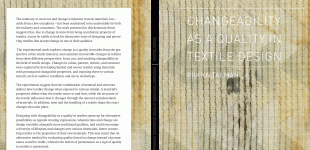
Riikka Talman Licentiate Thesis Abstract The tendency to wear out and change is inherent in most materials, but – aside from a few exceptions – has been considered to be undesirable by both the industry and consumers. The work presented in this licentiate thesis suggests that, due to change in some form being an inherent […]
On Textile Farming: Seeds as Material for Textile Design_Svenja Keune
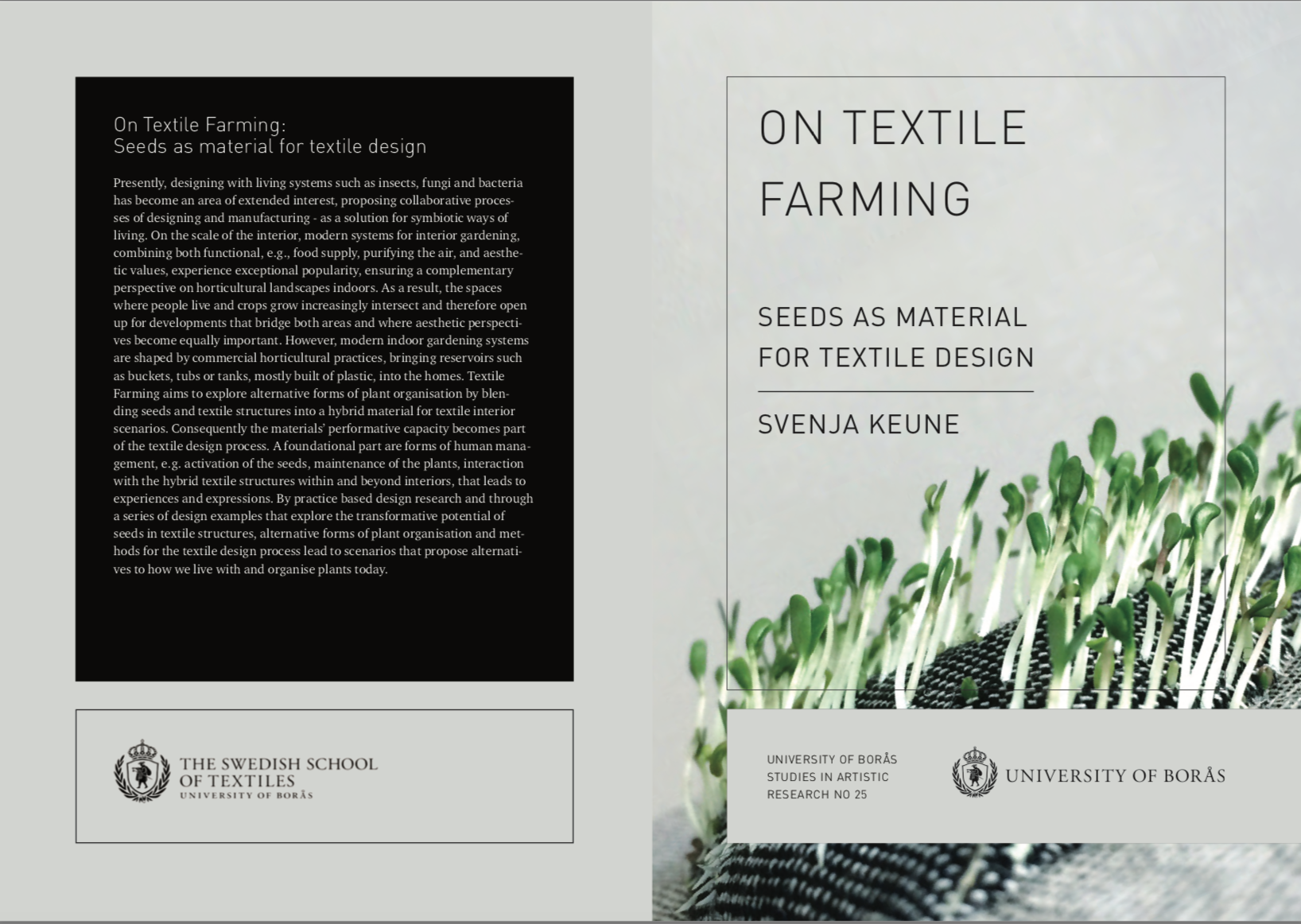
Presently, designing with living systems such as insects, fungi and bacteria has become an area of extended interest, proposing collaborative processes of designing and manufacturing – as a solution for symbiotic ways of living. On the scale of the interior, modern systems for interior gardening, combining both functional, e.g., food supply, purifying the […]
On researching and teaching in textile design

Artistic research in design is relatively new compared to experimental research in the natural sciences but it has matured a great deal over the last decade. Its extensive development has brought new challenges to professional practice, and also raised questions regarding how knowledge should be imparted in academia. By examining the field of textile design, […]
Research outlet_www.researchoutlet.se
Monday the 18th of December at 13.00 we will launch the Research Outlet at the Swedish School of Textiles. The research outlet is an ongoing project of the Smart Textiles Design Lab; the project aims to propose another perspective on research publishing. www.researchoutlet.se
Davis, F. and Dumitrescu, D.(2017). Knitted Heat-ActiveTextiles.In Active matter, Tibbits, S.(ed). Cambridge(MA): MIT Press, pp. 205-212.
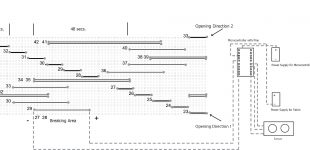
Dumitrescu, D. and Davis, F. (2017). Knitted Heat-ActiveTextiles.In Active matter , Tibbits, S.(ed). Cambridge(MA): MIT Press, pp. 205-212. https://mitpress.mit.edu/books/active-matter
On textile printing with thermochromic inks

This thesis describes an exploration of the principles of applying leuco dye-based inks to textile design practice. The main motivation has been to explore the design properties and potentials of leuco dye-based thermochromic inks when printed […]
Crafting butterfly lace- Conductive Multi-color sensor-Actuator Structure
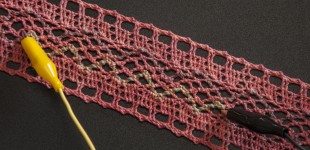
Kristi Kuusk, Marjan Kooroshnia and Jussi Mikkonen The development of Butterfly Lace started and carried on as an extension of ArcinTex network workshop (Arcintex, 2014). Multi disciplinary team of researchers collaborated while situated in three countries, to realize conductive multi-color sensor-actuator structure. Over several prototyping sessions, Skype conversations and e-mail exchange, the lace is made […]
Exploring the relation between time-based textile patterns and digital environments
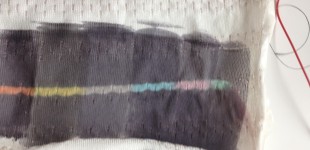
Dumitrescu, D., Kooroshnia, M, Landin, H.(2014). Exploring the relation between time-based textile patterns and digital environments. Proceedings Ambience’14, 7-9 September, Tampere Technical University, Tampere, Finland
Smart Textiles as Raw Materials for Design
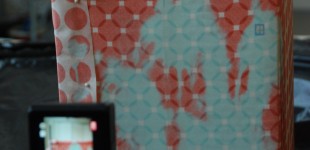
Dumitrescu, D., Nilsson,L., Persson, ,A., Worbin, L.,(2014). Smart textiles as raw materials for design. Proceedings Shape Shifting, Auckland, AUT, 14-16 April, Auckalnd, NZ. http://aut.researchgateway.ac.nz/handle/10292/8581
Relational Textiles:surface expressions in space design
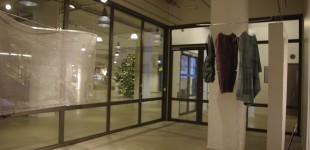
Dumitrescu, D. (2013). Relational Textiles:surface expressions in space design. PhD thesis. Studies in Artistic Research no. 7.Borås:The Swedish School of Textiles, University of Borås. http://bada.hb.se/handle/2320/12672 Relational Textiles: exhibition Knitted Forms in Movement(movie)
Composing over time, temporal patterns – in Textile Design
ABSTRACT The work presented in this thesis is a first attempt investigating a new field, exploring the visual effects of movement using light as a continuous time-based medium. Composing over time, temporal patterns – in Textile Design is a practice based research project that investigates the following research question: What does it mean, if time […]
Stretching Loops – Exploring interactive textiles expressing Imitation for recording and replaying interactions
ABSTRACT This paper presents Stretching Loops – design examples of sensing and reactive knitted textiles able to record and replay human interaction. Placed in a room, textile tubes imitate interactions performed by a human through motor control. As an example of basic research in the context of textile interaction design research, Stretching Loops is part […]
Exploring textiles as materials for interaction design
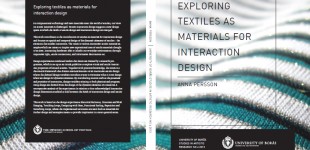
Persson, Anna. 2013. Exploring textiles as materials for interaction design. PhD thesis. The Swedish School of Textiles, University of Borås.
Relational Textiles for Space Design: design methods and expressions

Dumitrescu, Delia. 2011. Relational Textiles for Space Design: design methods and expressions. Department of Applied IT, Chalmers University of Technology and The Swedish School of Textiles, University of Borås.
An interactive textile hanging: textile, spaces, and interaction
ABSTRACT This article presents three scenarios in which we explore different possibilities for interactive textile hangings, textile hangings that are knitted and attached to servomotors. We have identified a series of variables that address the relationship between the expressions of the changeable pattern, created by rotating motors, and the unchangeable textile pattern. We use these variables, combined with contextual […]
Smart Textile Design Lab PUBLICATION LIST 2011
Another year, another summary. Below you can see all publications of Smart Textile Design Lab of 2011. [1] Dumitrescu, D., Persson, A. Heat as Interactive Expressions for Knitted Structures. In Koskinen, I., Härkäsami, T., Mazé, R., Mattews, B., Joo Lee, J., (Eds.) Proceedings of Nordes’11: the 4th Nordic Design Research Conference. School of Art and […]
rhythm exercise_13in1
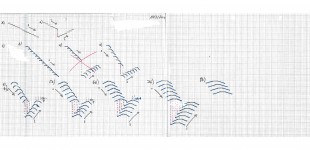
Abstract: The exhibit 13in1 is an example of my PhD research work which aims to answer the following research question: What does it mean to explore time and changing expression, in the form of continuous movement as an integral part of textile design? The aim is to create time-based textiles, which examine the aesthetics of […]

The Swedish School of Textiles
All content © 2026 by Smart Textiles Design Lab Blog